White Label Link Building: A Guide for Agencies
By Linkzy ·

White label link building is when your agency sells backlinks to clients under your own brand, while a specialist partner does the prospecting, outreach and placement behind the scenes. Done well, it lets you offer link building without hiring an in-house outreach team. Done badly, it puts your clients' rankings (and your reputation) at risk, so the partner you choose matters more than the price.
I spent years on the delivery side of this: running link building teams, managing publisher relationships and fulfilling campaigns for agencies whose clients never knew we existed. This guide covers how white label link building actually works, what to check before you resell anyone's links, and how to price and report it so it becomes a profitable service rather than a support headache.
What is white label link building?
In a white label setup, three parties are involved:
- The client, who pays your agency for SEO results.
- Your agency, which owns the client relationship, strategy and reporting.
- The fulfilment partner, who finds relevant sites, handles outreach, gets the content published and sends you the live links.
Everything the client sees carries your branding: the proposal, the reports, the invoices. The partner stays invisible. That is the key difference from a simple referral, where you pass the client to another company and step out.
Most agencies use it for one of three reasons. They have demand for links but not enough volume to justify a full-time outreach hire. They tried doing outreach in-house and found it slow and inconsistent. Or they want to add a service quickly to grow account value without changing their team.
How white label link building works, step by step

The workflow is fairly standard across good providers:
- Brief. You share the client's domain, target pages, niche, preferred anchor text mix and any no-go topics or competitors.
- Prospect list. The partner suggests sites. A good partner shows you the domains (or at least detailed metrics) before anything gets published so you can approve them.
- Outreach and content. The partner pitches the sites, agrees placements and writes or commissions the content.
- Publication. Links go live, usually as guest posts or niche edits on existing articles. If you want to understand the trade offs between those two formats, see our comparison of guest posting vs niche edits.
- Report. You receive the live URLs, anchors and metrics in a format you can rebrand and send to the client.
The whole cycle typically runs in weeks, not days, because real outreach to real site owners takes time. Be wary of anyone promising dozens of links within 48 hours.
The real benefits for agencies
You sell a service without building a department. Outreach is a specialist skill. It needs prospecting tools, publisher relationships, writers and a lot of follow up. A partner already has all of that.
Margins can be healthy. You buy at wholesale and resell inside a retainer or as a package. The exact markup depends on your market, but agencies commonly price link building as part of a monthly SEO plan rather than per link, which smooths out the cost of individual placements.
You keep the client relationship. Because everything goes out under your brand, the client keeps working with you instead of drifting to a link vendor.
Scale up and down with demand. If you sign three new clients next month, you increase the order. If one churns, you reduce it. No hiring or layoffs.
The risks nobody puts in the sales deck
This is the part I care about most, because I have seen what happens when agencies pick the cheapest option.
Low quality networks. Some providers sell links from sites that exist only to sell links: thin content, no real audience, every article linking out to a different "partner". These sites are easy to spot once you know the signs, and so is the risk. Our guide to what Google actually penalizes in link building walks through the patterns to avoid.
Policy risk. Google's spam policies treat links bought to manipulate rankings as link spam, and Google asks publishers to qualify paid links with rel="sponsored" or rel="nofollow". That does not mean every outreach placement is a problem, but it does mean the quality, relevance and editorial context of each link matter. Links that look and behave like editorial recommendations on relevant sites are a very different thing from bulk placements on link farms.
Your brand takes the hit. The client does not know your partner exists. If rankings drop or a disavow becomes necessary, the conversation happens with you.
Opaque reporting. If a provider will not show you the domains in advance or refuses to share real traffic data, assume there is a reason.
How to vet a white label link building partner
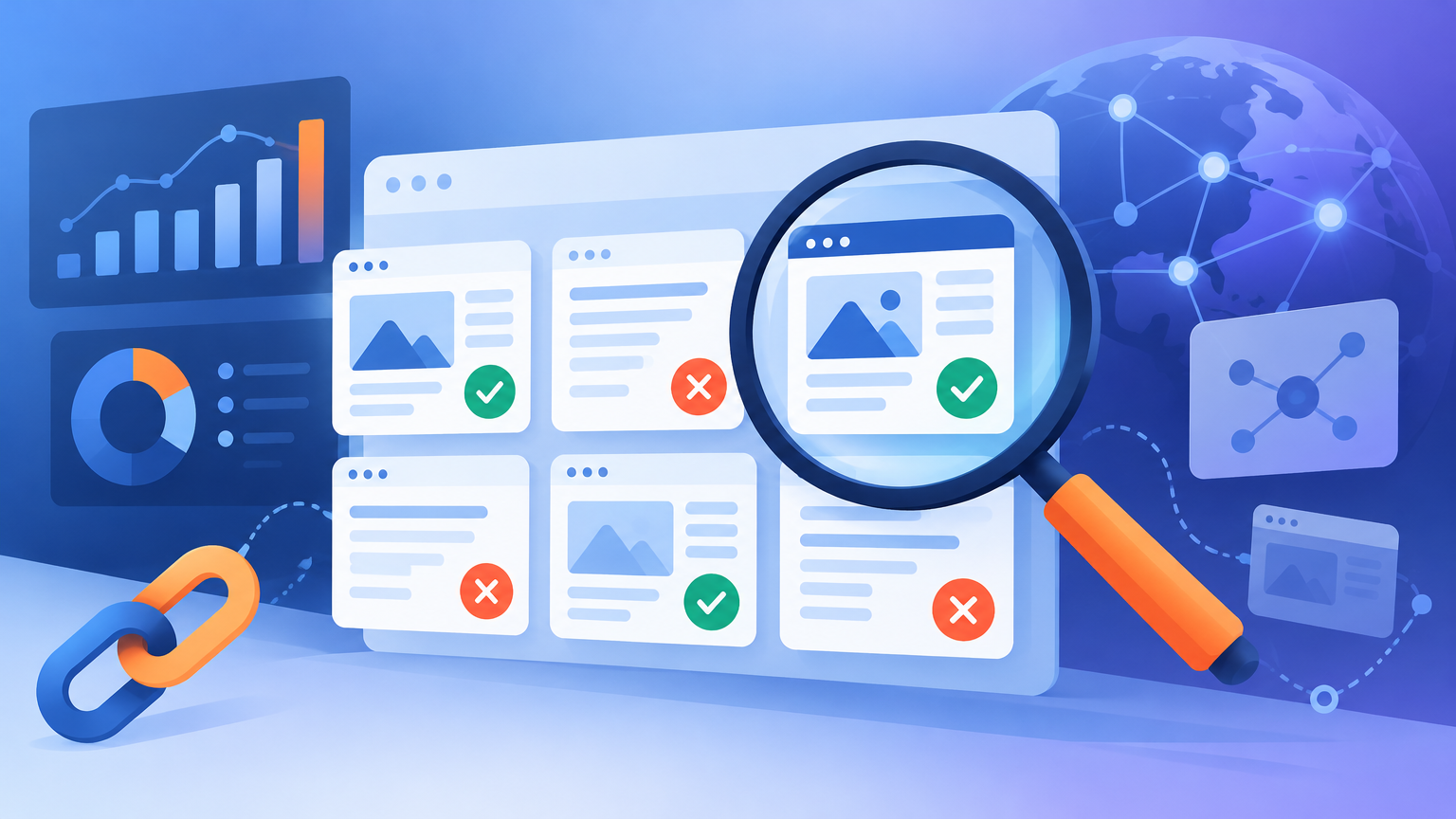
Use this checklist before you resell anyone's work:
| What to check | Good sign | Red flag |
|---|---|---|
| Site approval | You see domains before publication | "Our network is confidential" |
| Traffic | Real organic traffic from the target country, stable or growing | Traffic spikes, or traffic from unrelated countries |
| Relevance | Sites topically close to the client's niche | Generic "news" or "business" sites covering everything |
| Outbound links | A handful of editorial links per article | Every post links to a different commercial site |
| Content | Articles a real reader would finish | Spun or obviously AI-padded text |
| Pricing | Clear per link or package pricing tied to site quality | Very low flat prices for "DA 50+" links |
| Replacements | A stated policy if a link disappears | No answer, or only store credit |
| Reporting | White label reports with URLs, anchors and metrics | A spreadsheet with domain names only |
Two more things I always ask a potential partner:
- "Can I see three recent placements in my client's niche?" Real providers can show examples quickly.
- "How do you find these sites?" You want to hear about manual prospecting and outreach to site owners, not "our partner network".
For a wider view of what separates good links from filler, our guide to what quality backlinks really are goes deeper into the metrics worth trusting.
How to price white label link building for your clients
There are three common models:
Per link. Simple to explain, but clients start comparing your price per link with cheap marketplaces, which drags the conversation toward volume instead of quality.
Packages. For example, a monthly package with a fixed number of placements at different quality tiers. This is easier to sell and forecast, and it lets you mix one or two stronger placements with supporting links.
Bundled into an SEO retainer. Link building becomes one part of a monthly plan alongside technical work and content. This is usually the most defensible model, because the client is paying for outcomes and strategy, not a list of URLs.
Whatever model you use, build your price from the wholesale cost of the quality level you actually want, plus the time you will spend on strategy, approvals and reporting. Agencies often underestimate that management time.
Reporting links to clients the right way
Good reporting is what turns links into a renewal. Include:
- The live URL of every placement and the page it points to
- Anchor text used, so the client sees you are managing the anchor mix
- Key metrics for each referring domain (traffic and relevance, not just one authority score)
- Which target pages the links support and why those pages were chosen
- Movement in rankings or organic traffic for those pages over time
Keep in mind that links take time to show impact. Set that expectation in month one so the client is not judging the campaign on week three.
When white label link building is not the right fit
It is not the answer for every agency. If link building is your core offer and you want full control of your publisher relationships, building an in-house team may make more sense long term. If your clients are in tightly regulated niches, you may need deeper involvement in every placement than a typical white label process allows. And if a client needs digital PR and media coverage rather than niche placements, you need a partner with genuine journalist relationships.
Frequently asked questions
Is white label link building legal?
Yes. White labelling is a normal business arrangement where one company delivers a service that another company sells under its own brand. What matters for SEO is not the white label model itself but the quality of the links and whether they comply with search engine guidelines.
Is white label link building the same as buying links?
Not necessarily. Many white label providers earn placements through outreach and content, and some placements involve fees. Google expects paid links to be qualified with rel="sponsored" or rel="nofollow", so ask your partner how they handle this and focus on relevant, editorial placements.
How much does white label link building cost?
It varies widely with site quality and niche. Links on real, relevant sites with genuine traffic cost more than links from generic networks, and competitive niches like finance or health cost more again. Ask for pricing by quality tier rather than a single flat price.
How long until white label links show results?
Expect to wait. New links usually take weeks to a few months to be crawled and reflected in rankings, depending on the site, the competition and how often the linking pages are crawled.
Will my clients know I use a white label partner?
Not if the partner is truly white label. Reports, communication and invoices should all carry your brand, and the partner should never contact your clients directly.
Choosing a partner you can put your name behind
White label link building works when your partner treats your clients' sites as carefully as you would. Ask to see the domains, check real traffic and relevance, and insist on reporting you are proud to send. If you also want help with your outreach process, our link building outreach email templates are a good place to start.
If you would rather hand off the heavy lifting, Linkzy builds relevant, quality backlinks for agencies and in-house teams, with the transparency you need to resell them with confidence.